Art & Design
Introduction to Art and Design
At East Dene School we are artists! Our Art and Design curriculum has been designed after identifying barriers for children and creating four concepts known as our school drivers. Our school drivers are;
- creative collaborators,
- aspiring minds,
- memory makers
- our family, our community, our world.
We plan, deliver and evaluate our lessons by looking at the end points for drawing, painting and sculpture and the key learning they need to have been taught. Our curriculum provides all of our children from EYFS to Year 6, with opportunities to practice and develop skills and knowledge following a sequence of lessons. The sequence of lessons includes: understanding and explaining key vocabulary, exploring an artist and their artwork, practicing and developing new skills and techniques (drawing, paint or sculpture), creating a final piece of art work and evaluating their final piece. The topics provide our children with the knowledge of various artists (past and present day) and how to develop key elements of art such as; line, colour, shape, form, texture and tone. We allow children to develop and practice their skills and techniques over a number of lessons before applying them to a final piece of artwork. This allows our children to showcase their knowledge and skills they have acquired.
Curriculum Aims
At East Dene Primary School our curriculum aims to give every child the opportunity to become an artist.
We are Artists…
An artist is someone who uses creativity and imagination to make beautiful things. Artists share their unique way of seeing the world through their artworks in many forms like painting, sculpture, photography and more. If you have ideas and visions to express, you can be an artist too by finding your own style to create amazing art. 
Intent, Implementation, Impact
Intent:
At East Dene Primary School, we foster an understanding and enjoyment of art, craft and design. We aim to provide pupils with experience of a broad and balanced range of art activities, showing progression within these experiences. Pupils develop knowledge, ideas and techniques through the use of a sketchbook. We develop their ability to observe, investigate, respond to and record the world around them through a growing variety of forms and media. Pupils develop their use of a range of tools, media and processes. We aim to develop an understanding of the work of artists, craftspeople and designers and apply this knowledge to their own work. Pupils also study historical, cultural and religious art. Our art curriculum engages, inspires and challenges pupils, equipping them with the knowledge and skills to experiment, invent and create their own works of art. We strive to promote a lifelong love and appreciation of the visual arts.
Implementation:
- Pupils have weekly dedicated art lessons, as well as opportunities to apply art skills across the broader curriculum. Lessons allow time for both guided learning and open-ended creative exploration.
- The art curriculum progressively builds upon prior learning from year to year, increasing in complexity. Key concepts are revisited to allow consolidation of knowledge and skills.
- A wide range of high-quality materials and resources are available to pupils including paint, pastels, clay, textiles, collage materials and more.
- Artwork by famous artists and from different cultures is studied to inspire and expose pupils to diverse techniques and styles.
- Displays around the school celebrate pupils’ artwork and creativity.
- Specialist art workshops, visiting artists and gallery visits further enrich the curriculum.
Impact:
- Pupils are proud of their artwork and are eager to discuss the processes and techniques used.
- Sketchbooks show progression over time with growing creativity, skill and autonomy.
- Pupils develop a deepening understanding of the work of famous artists.
- The language of art is understood and used by pupils when evaluating their own and others’ artwork. Pupils leave the school with a love of art, eager to continue refining their skills. The art curriculum equips them with transferable skills such as problem solving, perseverance and creativity
Cultural Capital
At East Dene, our curriculum significantly enriches a child’s cultural capital in Art, Design, and Technology by providing a diverse array of creative opportunities and resources. The curriculum is designed to nurture artistic expression and technical skills through hands-on projects, trips, critical thinking and an exposure to a variety of artistic mediums and design principles. Students engage in activities that stimulate their imagination and critical thinking, such as creating original artworks, exploring cutting-edge technologies, and understanding the historical and cultural contexts of different art forms. This holistic approach not only enhances their artistic abilities but also instils a deep appreciation for the arts and fosters innovative thinking, preparing them for future academic and professional endeavours in a rapidly evolving world.
Progress Model
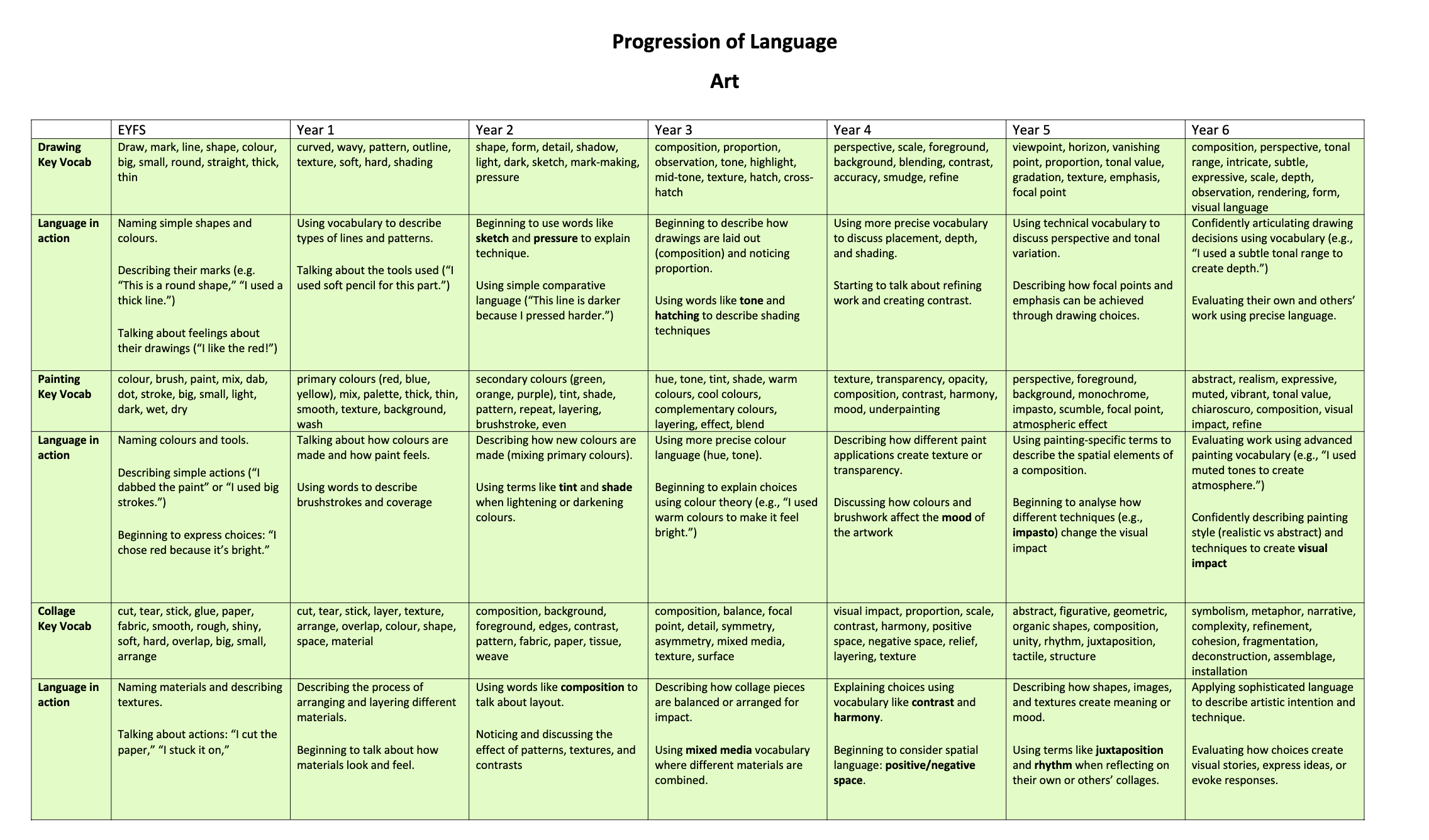
Progression of Language
Research around the Curriculum
Concepts
At East Dene, we understand the necessity of providing children with opportunities to revisit previous learning, committing knowledge to their long-term memories. In order for this to happen in art, we have carefully considered the concepts and knowledge that children will be taught and how these will be revisited and built upon each year, from EYFS through to Year 6.
In our art curriculum, we have categorised the concepts into primary key concepts, supplementary key concepts and integral concepts, with the latter being referred to during most units of work. The formal elements of art are known as our key concepts (primary and supplementary) that are taught through each block of learning, across the different mediums being taught and developed each year: Colour, Pattern, Texture, Line, Shape, Form and Space. These key concepts are the formal elements of art, and are the building blocks of any work of art. When we analyse any work of art, we analyse these elements to see how they combine to create the overall effect of the artwork. Formal elements can be both practical and theoretical, and it isn’t necessary to be able do both to understand them. When we analyse any drawing, painting, sculpture or design, we examine these component parts to see how they combine to create the overall effect of the artwork.
These elements have a relationship to one another:
- Most images begin their life as line drawings.
- Lines cross over one another to form shapes.
- Shapes can be filled with tone and colour, or repeated to create pattern.
- A shape may be rendered with a rough surface to create a texture.
- A shape may be projected into three dimensions to create form.
Each of the elements may also be used individually to stress their own particular character in an artwork.
The table below outlines how the primary and supplementary key concepts have been mapped out within our art curriculum:

In addition to the key concepts outlined above, we have our integral concepts, which are taught and referred to within the majority of art units at Coleridge. Source, style, movement & periods and themes are introduced from KS1; observation and reflection (along with the key concepts above) are introduced from Foundation Stage. An explanation of these concepts is outlined below:

Examples of Planning
Useful Websites
Here are some useful websites for parents to help children with art at home:
The Crayola website has lots of art activities, crafts, and ideas for parents to do with kids of all ages. They provide materials lists, step-by-step instructions, and photos.
The Artful Parent has art project ideas organized by age and medium like painting, drawing, sculpting, and mixed media. There are also tips for parent and managing art supplies.
Red Ted Art shares easy arts and crafts activities to do with children using everyday items found around the home.
The Imagination Tree provides open-ended creative art prompts and ideas to spark kids’ imaginations during art and craft time.
https://theimaginationtree.com/
The Tucson Museum of Art offers printable worksheets based on art in their collections. The activities are great for fine motor skills.
https://www.tucsonmuseumofart.org/
Tate Kids from the Tate museums has art activities, quizzes, and videos to get kids engaged in art.
The Met Museum provides interactive online art-making activities for kids inspired by works in the museum’s collection.
Drawing Glossary
EYFS (Nursery & Reception)
- Draw
To make marks or pictures using a pencil, crayon, or chalk. - Mark
A mark is any line, dot, or scribble you make on paper. - Line
A line is a mark that moves from one point to another. It can be straight, wavy, or curved. - Shape
A flat space made when lines join together, like a circle or square. - Colour
Colour is what we see when light hits something. Red, yellow, and blue are colours. - Big / Small
Big means large; small means little. We use these words to describe size. - Round
Round means curved like a circle or ball. - Straight
Straight means a line that doesn’t curve or bend. - Thick / Thin
Thick lines are wide; thin lines are narrow.
Year 1
- Curved
A line that bends smoothly without sharp angles. - Wavy
A line that moves up and down like waves. - Pattern
When shapes, lines, or colours repeat over and over. - Outline
The outside edge of a shape or drawing. - Texture
How something looks or feels, like rough or smooth. - Soft / Hard
Soft marks are light and gentle; hard marks are darker and stronger. - Shading
Making part of a picture darker to show shadow or depth.
Year 2
- Shape
A flat, enclosed space, like a circle, triangle, or square. - Form
A shape that looks 3D, like a cube or sphere. - Detail
Small parts added to make something more interesting or real. - Shadow
A dark area made when light is blocked. - Light / Dark
Light is bright; dark is deep or shaded. Artists use both to create contrast. - Sketch
A quick, light drawing to plan ideas. - Mark-Making
Using different lines, dots, or scribbles to create texture or pattern. - Pressure
How hard or softly you press with your pencil or crayon.
Year 3
- Composition
How everything is arranged in a picture. - Proportion
The right size of one part of a drawing compared to another. - Observation
Looking carefully at something before drawing it. - Tone
How light or dark an area of a drawing is. - Highlight
The brightest part of an object where light hits. - Mid-Tone
A shade that is between light and dark. - Texture
The look or feel of a surface in a drawing. - Hatch / Cross-Hatch
Hatch: lines close together. Cross-hatch: lines crossing over each other to show tone.
Year 4
- Perspective
Making things look like they go back into the distance. - Scale
How big or small something is in a picture compared to other things. - Foreground / Background
Foreground is the front; background is the far part behind. - Blending
Gently mixing colours or shades so they flow smoothly. - Contrast
The difference between light and dark or bold and soft. - Accuracy
Drawing something carefully and correctly. - Smudge
Rubbing pencil or charcoal to soften edges or create shadow. - Refine
To improve and add small details to a drawing.
Year 5
- Viewpoint
The angle you see something from (above, side, front). - Horizon
The line where the sky meets the ground. - Vanishing Point
A spot on the horizon where lines seem to meet in the distance. - Proportion
The right size and position of one part of a drawing to another. - Tonal Value
The range from light to dark in a drawing. - Gradation
When colour or tone changes slowly from light to dark. - Texture
How something looks like it would feel in real life. - Emphasis
Making something stand out in a picture. - Focal Point
The most important part of the picture that draws your eye.
Year 6
- Composition
How every part of a picture is arranged to create balance or drama. - Perspective
Making objects look smaller as they get further away. - Tonal Range
Using light, mid, and dark tones to add depth and contrast. - Intricate
Something very detailed and carefully done. - Subtle
A gentle or soft change in colour, tone, or line. - Expressive
Showing feelings or mood through drawing. - Scale
The size of one object compared to others in the picture. - Depth
Making a picture look like it has space going back or forward. - Observation
Looking very closely to capture details. - Rendering
Adding tone, texture, and detail to make something look realistic. - Form
The 3D shape of an object. - Visual Language
Telling a story or sharing an idea through images instead of words