

Mathematics
Foundational Knowledge
Building Strong Mathematical Foundations at East Dene Primary School
At East Dene Primary School, we believe that success in mathematics begins with secure foundational knowledge. Foundational knowledge is the essential understanding, facts, skills and language that children need before they can successfully learn more complex mathematical concepts. Just as a house needs strong foundations before it can be built higher, children need secure mathematical foundations to become confident and successful mathematicians. Research shows that when children develop a deep understanding of fundamental mathematical concepts early, they are better able to make connections, reason mathematically and solve problems as they progress through school.
The Foundations of Mathematical Learning
At East Dene Primary School, we believe that success in mathematics begins with secure foundational knowledge. Foundational knowledge is the essential understanding, facts, skills and language that children need before they can successfully learn more complex mathematical concepts. Just as a house needs strong foundations before it can be built higher, children need secure mathematical foundations to become confident and successful mathematicians. Research shows that when children develop a deep understanding of fundamental mathematical concepts early, they are better able to make connections, reason mathematically and solve problems as they progress through school.
Our Approach in the Classroom
We want all children to feel successful, included and engaged in mathematics lessons. Children needing support in a particular lesson begin learning alongside their peers and take part in whole-class teaching, discussion and reasoning activities. We believe that every child should have access to high-quality mathematical learning and opportunities to develop their understanding alongside their classmates. Teachers carefully adapt learning to ensure all children can succeed by identifying and securing the knowledge needed before new learning is introduced. Learning is broken down into small, manageable steps and supported through mathematical talk, sentence stems, concrete resources and visual representations. Where additional support is needed, children may take part in short bespoke activities that focus on the foundational knowledge required to access the current learning. Wherever possible, this support is linked directly to the year group objective being taught, enabling children to strengthen essential mathematical understanding while remaining connected to the wider curriculum.
Developing Fluency with Number Facts
At East Dene Primary School, we recognise that fluent recall of key number facts is essential for success in mathematics. Through the NCETM Mastering Number programme, children develop a deep understanding of number and the relationships between numbers, rather than simply memorising facts. This helps children become more efficient, flexible and confident mathematicians. In Reception to Year 3, Mastering Number focuses on developing strong additive fluency and number sense. Children explore the relationships between numbers, secure number bonds, develop confidence with addition and subtraction facts, and build understanding through subitising, counting and recognising number patterns. This creates the firm foundations needed for future mathematical learning. From Years 4 to 6, the focus shifts towards developing conceptual understanding and fluency in multiplication and division. Children deepen their understanding of multiplicative relationships, times tables and division facts, enabling them to apply these efficiently and accurately when solving more complex mathematical problems. To ensure every child develops secure number fact knowledge, pupils from Years 1 to 6 are regularly assessed to identify gaps in fluency and understanding. Assessment information is used to provide timely interventions and targeted support, helping children strengthen key number facts and secure the mathematical foundations needed to access the wider curriculum. Through this approach, we aim for all children to develop confidence, flexibility and fluency with number.
Why This Matters
Our goal is not simply to help children complete today’s lesson. Our goal is to ensure that children develop the secure mathematical foundations they need for long-term success. Through our Foundational Knowledge approach, children develop:
- Confidence in mathematics.
- Strong number sense and fluency.
- Secure understanding of key concepts.
- Mathematical language and reasoning skills.
- Greater independence and resilience.
- Improved access to age-related expectations.
By systematically developing these foundations, we help every child build the knowledge, confidence and understanding needed to become successful mathematicians both now and in the future.
Foundational Knowledge
Yearly Overview
2024/2025
Intent, Implementation, Impact
Progression of Language
The tables show the progression of language across each curriculum area. The language is built over time and each year group only shows the new vocabulary in that year group. So previous year group language should be used as language builds over time.
The glossary at the bottom of the document gives definitions which should be used across school so that these are used consistently. The words highlighted in red are those that are described.
Areas of National Curriculum covered
- Number and Place Value
- Addition/Subtraction and estimation
- Multiplication and Division
- Fractions, Decimals and percentages (inc. ratio and algebra in Year 6)
- Measurements
- Statistics
- General


Number Fact Knowledge at East Dene Primary School
Why Number Facts Matter
At East Dene Primary School, we believe that strong number fact knowledge is fundamental to success in mathematics. Children need to develop secure, fluent and flexible knowledge of number facts to become confident and successful mathematicians.
Without secure number fact knowledge, children may find it difficult to reason mathematically, solve problems and apply their understanding to increasingly complex mathematical concepts as they progress through school.
Fluent recall of number facts reduces the cognitive load involved in calculation, allowing children to focus their thinking on the mathematical structure of a problem rather than the individual calculations.
For this reason, developing number fact knowledge is a key priority across East Dene Primary School and is taught explicitly through dedicated sessions from Reception through to Year 6.
Our approach is carefully sequenced to ensure children build their knowledge progressively, moving from early understanding of quantity and number relationships towards increasingly sophisticated multiplicative and proportional reasoning.
Our Number Fact Roadmap: Reception to Year 6
At East Dene Primary School, we recognise that children develop mathematical fluency at different rates. Our number fact progression ensures that learning builds upon secure prior knowledge, allowing children to develop confidence, accuracy and efficiency.
Throughout this journey, mathematical language is developed alongside number fact knowledge, enabling children to explain their thinking, recognise patterns and make connections between mathematical concepts.
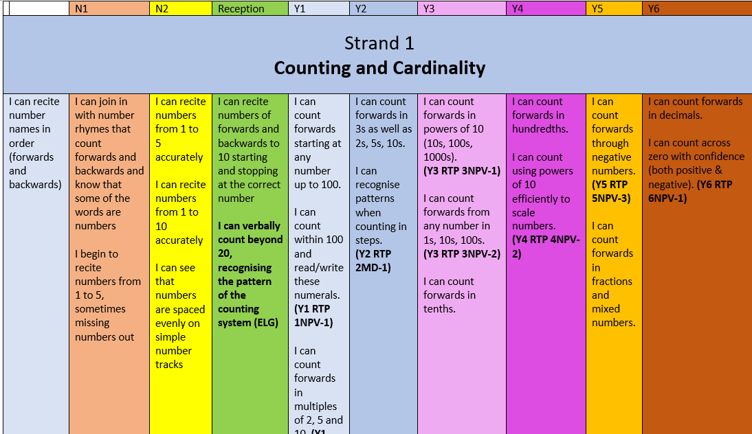
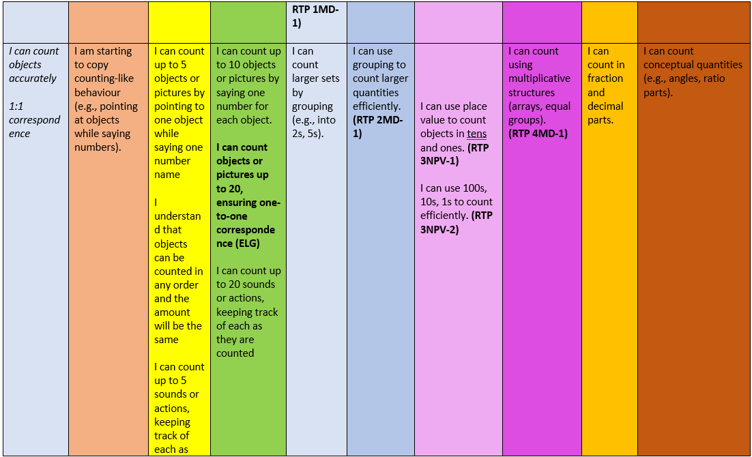
Reception – Subitising, Counting and Number Composition
Children develop their early understanding of number through subitising, counting and exploring how numbers are composed of smaller parts.
They learn to recognise small quantities without counting individual objects, compare amounts and develop an understanding of the relationships between numbers.
These early experiences provide the essential foundations for addition, subtraction and future mathematical learning.
Years 1 and 2 – Addition and Subtraction Facts
Following the principles of the NCETM Mastering Number programme, children develop secure additive fluency and a deeper understanding of number relationships.
Children focus on developing efficient recall of number bonds, addition and subtraction facts, while exploring patterns and connections between numbers.
Through practical experiences, visual representations and mathematical discussion, children develop flexibility in how they use and apply their number fact knowledge.
Year 3 – Introducing Multiplication and Division Facts
Building upon secure additive knowledge, children begin their formal times tables programme.
Learning begins with developing a conceptual understanding of multiplication and division through equal groups, repeated addition and arrays.
Children explore the relationship between multiplication and division before developing fluent recall of multiplication facts.
This ensures that children understand the meaning behind the facts they are learning rather than relying solely on memorisation.
Years 4 to 6 – Developing Multiplicative Fluency
As children progress through Key Stage 2, they continue to strengthen and consolidate their multiplication and division facts.
Children develop a deeper understanding of factors, multiples and the relationships between numbers. They increasingly apply their number fact knowledge to fractions, decimals, percentages and ratio.
In Year 4, children complete the statutory Multiplication Tables Check (MTC), which provides an opportunity to assess their fluency in recalling multiplication facts.
Throughout Years 5 and 6, number fact knowledge continues to be revisited and strengthened to ensure children can apply their understanding confidently when reasoning, solving problems and working with increasingly complex mathematical concepts.
Our aim is for every child to develop secure number fact knowledge, efficient recall, strong mathematical language and the confidence to apply their understanding across the mathematics curriculum.
How We Teach Times Tables
At East Dene Primary School, our structured times tables programme begins in Year 3 and continues throughout Key Stage 2.
We believe that children should understand multiplication before being expected to recall facts automatically. Each new multiplication table is therefore introduced through practical experiences involving equal groups, arrays and mathematical representations.
Once children have developed a secure understanding of the multiplication facts, regular oral rehearsal and retrieval practice help strengthen recall and build fluency.
Our Daily Times Tables Routine
Our consistent approach provides children with regular opportunities to practise, retrieve and consolidate their multiplication facts.
- Learn and revisit: Children learn a new multiplication fact and rehearse previously taught facts.
- Chant and rehearse: Children orally practise familiar multiplication tables to develop rhythm, confidence and fluency.
- Retrieve: Children complete a short, two-minute times tables test to practise recalling facts accurately and efficiently.
- Review: Children mark their own answers, reading each multiplication fact aloud to reinforce mathematical language and understanding.
- Track progress: Results are recorded on a tracking spreadsheet, allowing children and staff to monitor progress and identify areas requiring further practice.
For example:
3 × 2 = 6 — Three twos are six.
This consistent oral rehearsal helps children develop familiarity with multiplication facts and strengthens their understanding of mathematical relationships.
Repeated retrieval and practice support the development of increasingly automatic recall, allowing facts to become securely embedded in long-term memory.
As children’s recall becomes more fluent, they are able to focus their attention on reasoning, problem-solving and applying multiplication and division in more complex mathematical contexts.
Assessment and Targeted Support
At East Dene Primary School, we recognise the importance of identifying gaps in number fact knowledge early and providing timely support to ensure all children can make progress.
Teachers regularly assess children’s fluency and understanding, using times tables test results and Times Tables Rock Stars heat maps to identify specific facts that children find challenging.
This information is used to inform teaching, targeted interventions and opportunities for additional practice.
Children’s individual learning needs are supported through:
- Focused morning activities that revisit key number facts.
- Short, targeted interventions to address identified gaps.
- Regular retrieval practice and questioning during lessons.
- Additional support from teaching assistants.
- Opportunities for Year 6 times tables buddies to support younger pupils.
- Ongoing monitoring of individual progress through assessment and tracking.
All staff are encouraged to understand which multiplication tables children are currently learning and which facts require further reinforcement, ensuring opportunities for practice are embedded throughout the school day.
We recognise and celebrate individual improvement alongside high achievement, encouraging children to develop confidence, perseverance and a positive attitude towards mathematics.
Closing Gaps and Securing Foundations
We understand that children acquire and retain number facts at different rates. Our priority is to identify gaps in knowledge quickly and provide appropriate support before these gaps become barriers to future learning.
Through regular assessment, responsive teaching and targeted intervention, we aim to ensure that all children develop the secure foundational knowledge needed to access their year group curriculum.
Our approach is not simply about memorising number facts or achieving high scores in timed tests. It is about ensuring that children understand mathematical relationships, develop efficient and flexible recall, and can confidently apply their knowledge in a range of mathematical situations.
At East Dene Primary School, we are committed to helping every child develop the fluency, confidence and mathematical understanding needed to become a successful mathematician, both now and in the future.
Policies
The Multiplication Check
The New Multiplication Tables Check Explained
All Y4 children will have their multiplication skills formally tested in the summer term of Year 4 from 2020. The Multiplication Tables Check (MTC) was officially announced by the Department for Education (DfE) in September 2017. It will be administered for children in Year 4, starting in the 2019-20 academic year.
Multiplication tables check
Primary-school children are expected to know all their times tables up to 12×12. Under the current National Curriculum, children are supposed to know their times tables by the end of Year 4, but they are not formally tested on them other than through multiplication questions in the Year 6 maths SATs.
The DfE says that the check is part of a new focus on mastering numeracy, giving children the skills and knowledge they need for secondary school and beyond. The purpose of the MTC is to determine whether Y4 pupils can recall their multiplication tables fluently.
The times tables test will be introduced in English schools only. It will be taken by children in Year 4, in the summer term (during a three-week period in June; schools will decide which day to administer the check).
In June 2019 the multiplication check will be voluntary (schools will be able to decide whether to administer it or not). In June 2020 it will become compulsory. Children with special educational needs will be provided for when taking the MTC.
How will the children be tested?
- Children will be tested using an on-screen check (on a computer or a tablet), where they will have to answer multiplication questions against the clock.
- The test will last no longer than 5 minutes and is similar to other tests already used by primary schools. Their answers will be marked instantly.
- Children will have 6 seconds to answer each question in a series of 25.
- Questions will be selected from the 121 number facts that make up the multiplication tables from 2 to 12, with a particular focus on the 6, 7, 8, 9 and 12 times tablesas they are considered to be the most challenging. Each question will only appear once in any 25-question series, and children won’t be asked to answer reversals of a question as part of the check (so if they’ve already answered 3 x 4 they won’t be asked about 4 x 3).
- Once the child has inputted their answer on the computer / device they are using, there will be a three-second pause before the next question appears.
How can you help your children at home?
- Encouraging your children to practice using TT Rockstars at home!
- Practising times tables in order or in a song.
- Asking your child multiplication questions out of order – such as ‘What’s 11×12? What’s 5×6?’
- Using arrays to help your child memorise times tables – you can use fun objects like Smarties or Lego bricks to make it more entertaining.
- Use the practice books given to your child.