Read, Write, Inc
Learning to Read
Read Write Inc. Phonics
At East Dene Primary School, we use Read Write Inc. (RWI), a systematic synthetic phonics programme, to teach children to read and write. Phonics helps children understand the relationship between letters and sounds, enabling them to read words by blending sounds together and spell words by identifying the sounds they hear.
Through RWI, children learn to recognise and say the sounds represented by letters and groups of letters (known as speed sounds). They develop the skills to blend these sounds to read words and use their phonics knowledge to spell when writing. As children become more confident, they develop greater accuracy, fluency and independence when reading.
How Does Read Write Inc. Work?
Children take part in regular, focused phonics sessions, working in small groups with a teacher or trained teaching assistant. They are grouped according to their phonics knowledge and reading ability, allowing teaching to be matched closely to their needs.
During RWI sessions, children:
- Learn to recognise and say new sounds.
- Practise blending sounds together to read words.
- Develop their ability to read words quickly and accurately.
- Read carefully matched books that contain the sounds they have been taught.
- Build reading fluency through regular practice and rereading.
- Develop their spelling skills.
- Talk about what they have read and answer questions to develop their understanding.
Children are regularly assessed by our Reading Leader, to monitor their progress and make sure they are learning at the right pace. Groups are reviewed regularly, and children move through the programme as their knowledge, confidence and fluency develop.
Reading Books and Reading at Home
Children are given reading books that are carefully matched to the phonics sounds and words they have been taught. This means they can use the skills they have learnt in their phonics sessions to read their books with increasing confidence and independence.
Children also bring home books to practise their reading and build fluency. Regular reading at home makes a huge difference, and we encourage parents and carers to listen to their child read as often as possible.
Alongside phonics, we place great importance on developing a love of books. Children enjoy listening to stories, poems and rhymes every day. Sharing books helps children develop their vocabulary, imagination, listening skills and understanding of language. Talking about stories, characters and events also helps children develop their comprehension skills.
Supporting Every Child to Become a Reader
At East Dene, we want every child to become a confident, fluent and enthusiastic reader. We recognise that every child is different and develops their reading skills at their own pace. We provide support, encouragement and opportunities to help all children make progress, develop their confidence and enjoy reading.
We believe that learning to read opens the door to a world of opportunities. Our aim is to nurture a love of books, stories and reading that children will carry with them throughout their lives.
Lessons
Our Read Write Inc. phonics lessons are carefully structured to help children develop the skills they need to become confident readers and writers. Children learn new sounds, practise blending them to read words and gradually apply their phonics knowledge when reading books and writing sentences.
Learning the Sounds
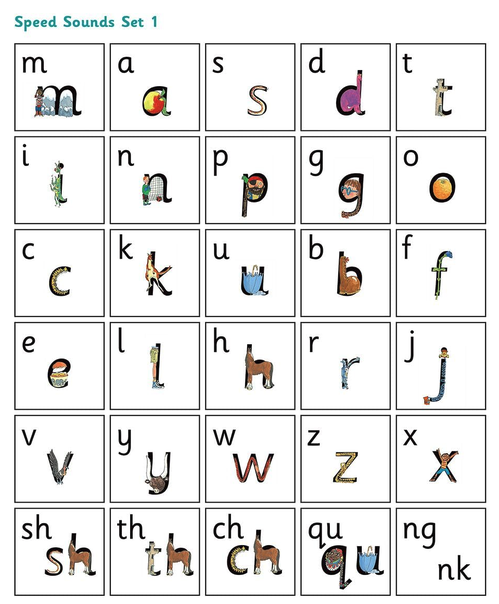
Children begin by learning Set 1 Speed Sounds. These include individual letter sounds, such as m, a, s, d, t, as well as sounds made by two letters working together, known as special friends.
As children become familiar with the sounds, they learn to blend them together to read words. This begins with listening to and blending sounds orally before moving on to reading written words.
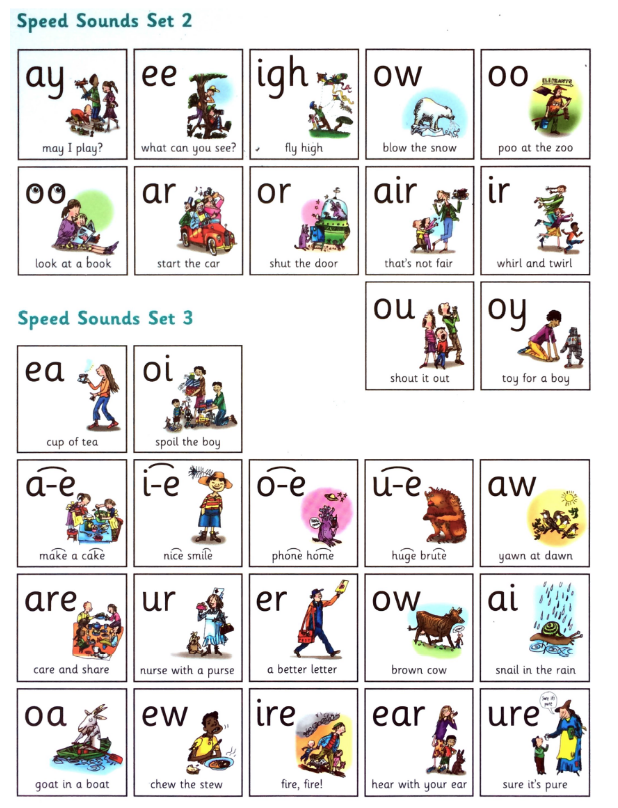
Once children are confident with Set 1 sounds, they move on to Set 2 Speed Sounds. These are sounds made by two or three letters working together to represent one sound, such as:
- ay as in play
- ee as in tree
- igh as in high
Children learn a picture prompt and a memorable phrase to help them remember each sound. They also practise reading words containing the new sounds, helping them apply what they have learnt.
As their phonics knowledge develops, children are introduced to Set 3 Speed Sounds. These teach alternative ways of spelling sounds they already know, for example:
- ee as in tree
- ea as in tea
This helps children recognise that the same sound can be represented in different ways when reading and writing.
The Order We Teach the Sounds
Children are taught the sounds in a planned sequence, allowing them to build their knowledge step by step.
Additional Sounds
Alongside the main speed sounds, children are also taught some additional sounds and spelling patterns. These include:
| Sound | Memory phrase |
|---|---|
| ue | Come to the rescue! |
| ie | Terrible tie! |
| au | Paul the astronaut |
| e_e | Go Steve and Pete! |
| kn | Knock knock, who’s there? |
| ck | Tick tock clock |
Learning to Blend – Fred Talk
In Read Write Inc., children use a special character called Fred the Frog to help them learn to blend sounds together.
Fred can only speak in sounds, so children learn to say each sound in a word before blending them together to say the whole word. For example, children might hear the sounds c-a-t and blend them together to read cat.
Children practise this regularly until they become confident at blending sounds and reading words more fluently.
As children develop their blending skills, they move on to reading short words, phrases and sentences. They also begin to use their phonics knowledge to write words and sentences of their own.
Nonsense Words (Alien Words)
As children learn more sounds, they practise using their phonics knowledge to read unfamiliar words. These include real words and made-up words, often called alien words.
Reading nonsense words helps children develop their ability to recognise letters, say the correct sounds and blend them together, rather than relying on words they already know.
This is also an important skill for the Year 1 Phonics Screening Check, which includes both real and made-up words.
Reading Books and Storybook Lessons
As children’s reading skills develop, they progress through a range of carefully matched books.
Children begin by reading simple words and sentences before moving on to books that are matched to the sounds they have been taught. These include:
- Green words: Words that children can sound out and blend using their phonics knowledge.
- Red words: Words that contain sounds that cannot yet be read using the phonics they have learnt and need to be recognised in a different way.
- Challenge words: Words that help extend children’s vocabulary and reading skills.
Before reading a story, children practise the words they will come across. This helps them read the story with greater confidence, accuracy and fluency.
Reading lessons also include opportunities to talk about the story, discuss characters and events, answer questions and explore new vocabulary. Children take part in partner discussions and related writing activities to develop their understanding of what they have read.
We want children not only to learn how to read the words on a page, but also to understand, enjoy and talk about the stories they read.
Parent Information
At East Dene Primary School, we use Read Write Inc. (RWI) to support children in learning to read and spell.
We know that children make the best progress when school and home work together. There are lots of simple ways you can support your child with their phonics and reading at home.
Supporting Phonics at Home
Your support at home is really important. Alongside reading regularly with your child, we ask that you practise the phonics sounds they are currently learning.
Teachers will send home a QR code that gives you access to RWI phonics videos for sounds your child has not yet learnt. These short videos provide an opportunity for children to hear and practise the sounds they are working on in school.
We would really appreciate it if children could use these videos at home alongside their regular reading. Even a few minutes of extra practice can help children become more confident with the sounds they are learning.
If you are unsure about how to pronounce a sound or support your child with their reading, please speak to your child’s teacher.
Phonics Workshops
We regularly hold Phonics Workshops for parents and carers throughout the school year.
These sessions are designed to help you understand how we teach phonics and reading at East Dene and, most importantly, give you practical ideas for supporting your child at home.
Our workshops are friendly and informal, with opportunities to see how phonics is taught and ask questions. Some sessions may also include practical activities and resources that you can use with your child at home.
We strongly encourage parents and carers to attend where possible, particularly if your child is beginning their phonics journey.
Reading at Home
Reading at home regularly is one of the best ways you can support your child’s progress.
Try to make reading a positive and enjoyable part of your child’s routine. Talk about the book together, ask questions about what is happening and encourage your child to talk about the characters, events and new words they come across.
Your child’s reading book will be matched to their current reading and phonics level, allowing them to practise the skills they are learning in school.
How Children Are Supported in School
Children are assessed regularly so that staff can understand their progress and identify any areas where they may need additional support or further challenge.
Children work in groups that are matched to their current needs, and groups are reviewed regularly as children develop their phonics knowledge and reading fluency.
Our aim is to make sure that every child receives the support they need to become a confident and enthusiastic reader.
Phonics Screening Check
At the end of Year 1, children take the Phonics Screening Check,a statutory assessment set by the Government.
The check helps us to identify how confidently children can use their phonics knowledge to read unfamiliar words and whether they may need further support.
If a child does not meet the expected standard in Year 1, they will have further opportunities to develop their phonics skills and will usually take the check again in Year 2.
The check is completed individually with a familiar adult in school.
Phonics Screening Check Information
For more information about the Phonics Screening Check, including materials from previous years, please visit the official GOV.UK website:
- 2024 Phonics Screening Check materials – View the 2024 materials
- 2025 Phonics Screening Check materials – View the 2025 materials
- 2026 Phonics Screening Check materials – View the 2026 materials
These pages provide information and materials relating to the Phonics Screening Check for each year.
We Are Here to Help
If you have any questions about your child’s phonics or reading, please speak to their class teacher or Mrs Middleton the reading leader.
We value the partnership between home and school and appreciate everything families do to support children’s reading at home.
Phonics Screening Check
What is the Phonics Screening Check?
The Phonics Screening Check is a statutory assessment that takes place at the end of Year 1. It is designed to check whether children have developed the phonics skills they need to decode words and read them accurately.
The check takes place in June and consists of 40 words. These include a mixture of real words and made-up words, sometimes called alien words or nonsense words.
Children complete the check individually with a familiar adult in a quiet setting. There is no time limit, so children can work through the words at their own pace.
Why Do Children Take the Check?
The purpose of the Phonics Screening Check is to help teachers understand how well children are developing their phonics skills and whether they have reached the expected standard for the end of Year 1.
The results help us identify any sounds or skills that may need further practice and support. If a child does not reach the expected standard in Year 1, they will continue to receive support with their phonics and will usually take the check again in Year 2.
It is important to remember that the check is not something for children to worry about. It is simply one way of helping us understand their progress and how best to support their reading development.
What Are ‘Alien’ or Nonsense Words?
Some of the words in the check are made-up words that children will not recognise. These are included to see whether children can use their phonics knowledge to sound out and read unfamiliar words, rather than relying on words they have already learnt.
Each alien word is accompanied by a picture of an imaginary creature. This helps children recognise that it is not a real word and that they need to use their phonics skills to work it out.
Children are already familiar with this approach through their Read Write Inc. lessons.
What Is the Expected Standard?
The Phonics Screening Check is marked out of 40. The Government sets a threshold mark each year to indicate whether a child has met the expected standard.
The threshold can vary from year to year depending on the difficulty of the check. Recent threshold marks have been:
| Year | Expected threshold |
|---|---|
| 2024 | 32 out of 40 |
| 2025 | 32 out of 40 |
| 2026 | 31 out of 40 |
The threshold is not a measure of a child’s overall ability or potential as a reader. It is one part of the information teachers use to understand progress and identify any additional support that may be needed.
Frequently Asked Questions
How is the check administered?
Each child completes the check individually with a familiar adult in a quiet area. There is no time limit, and children are encouraged to work through the words at their own pace.
Will we be told about our child’s results?
Yes. Parents and carers will be informed of their child’s result as part of the school’s end-of-year reporting.
What happens if my child does not reach the expected standard?
Your child will continue to receive support with their phonics and reading. They will usually take the Phonics Screening Check again in Year 2, giving them another opportunity to demonstrate their progress.
When does the Phonics Screening Check take place?
The check takes place during a designated week in June each year.
In 2026, the check was scheduled for the week beginning Monday 8 June.
How can we support our child at home?
The best way to support your child is to read together regularly and encourage them to practise the sounds they are learning in school.
You can also use the RWI phonics videos shared by your child’s teacher. These provide a helpful way to practise sounds at home.
For more advice, please visit our Read Write Inc. – Parent Information page.
Official Phonics Screening Check Information
The Department for Education provides further information and previous assessment materials on the GOV.UK website.
Reading at Home Top Tips
Helping Children Become Lifelong Readers
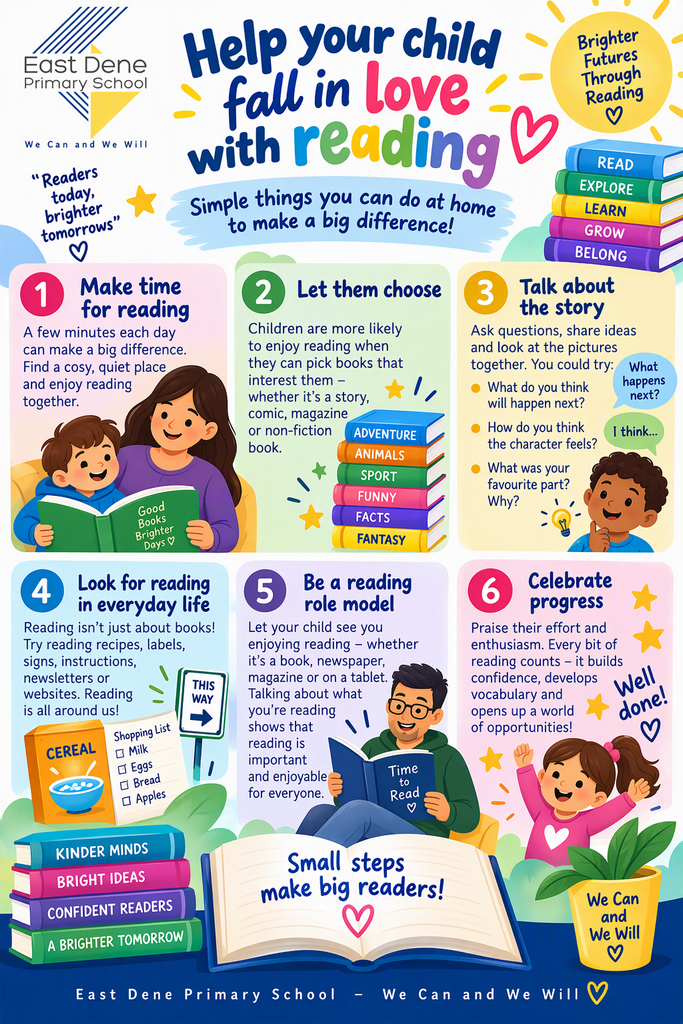
Reading is one of the most important skills children will develop, and families play a vital role in helping children become confident, enthusiastic readers. Reading with and to your child at home not only supports their reading development, but also has a significant impact on their speaking and listening skills, vocabulary and understanding of the world around them.
When children are read to, they are exposed to a rich range of words, phrases and language structures that they may not hear in everyday conversations. Stories introduce new vocabulary, spark curiosity and help children make connections between ideas, experiences and knowledge. This regular exposure to language builds strong foundations for communication, comprehension and writing.
Talking about books is just as important as reading them. Discussing characters, exploring new words, asking questions and sharing opinions encourages children to develop their speaking and listening skills while deepening their understanding of what they have heard or read. These conversations help children become more confident communicators and critical thinkers.
Whether you are reading a bedtime story, sharing a favourite book, listening to your child read or simply talking about a story together, every reading experience matters. Just a few minutes each day can make a lasting difference to your child’s confidence, vocabulary, imagination and love of learning.
Together, we can nurture confident readers, skilled communicators and lifelong learners.