
Geography
Introduction to Geography
At East Dene Primary we are geographers!
Children investigate a range of places (both in Britain and abroad) to help develop their knowledge and understanding of the Earth’s physical and human processes. At East Dene, we are committed to providing children with opportunities to investigate and make enquiries about their local area of Rotherham and South Yorkshire so that they can develop a real sense of who they are, their heritage and what makes our local area unique and special. We also develop the children’s ability to apply geographical skills to enable them to confidently communicate their findings and geographical understanding to a range of audiences.
Overview
Geography – Whole School Overview 24-25
Geography – Long Term Retrieval
Curriculum Aims
Our primary geography curriculum aims to:
- Inspire curiosity and wonder about the diverse world in our pupils who come from a wide range of cultures.
- Equip pupils with substantive geographical knowledge taught through recurring concepts that spiral in complexity.
- Ensure the curriculum is progressively sequenced, building locational knowledge and skills overtime.
- Make learning relevant through exploring contemporary issues and real-world connections.
- Develop spatial awareness, mapwork skills, and fieldwork capabilities through local environment.
- Promote care for the environment and sustainable futures through geographical enquiry.
- Foster intercultural understanding and celebrate the diversity of people, places and cultures globally.
- Build transferable geographical skills to analyse issues, think critically and communicate findings.
- Provide disadvantaged pupils with cultural capital to access future opportunities.
- Inspire pupils to recognize geography’s relevance to their lives and roles as global citizens.
- Spark curiosity that leads to lifelong geographical interest and learning.
These aims deliver an ambitious, equitable and inspiring geography curriculum, rooted in Ofsted’s focus on locational knowledge, fieldwork skills and geographical concepts while reflecting our diverse school community and contemporary world.
Cultural Capital
Geography education provides a meaningful way for East Dene to expand the cultural capital of its pupils. Exploring diverse global cultures, landscapes, and perspectives through the geography curriculum exposes our children to worlds beyond their immediate environment. We as teachers can leverage the subject to foster wonder about different places, people, languages, architecture, foods, music, and traditions. Field trips to varied neighbourhoods, museums, cultural festivals, or geographical features within the region bring learning to life while building background knowledge. Mapping activities teach spatial awareness and highlight connections across communities. Engaging with geospatial technologies like Google Earth opens doors to exploring the world from one’s classroom. With an empowering cultural geography approach, we at East Dene can equip pupils with the spatial literacy, critical thinking skills, and intercultural understanding necessary to become informed, engaged citizens in an increasingly interconnected world.
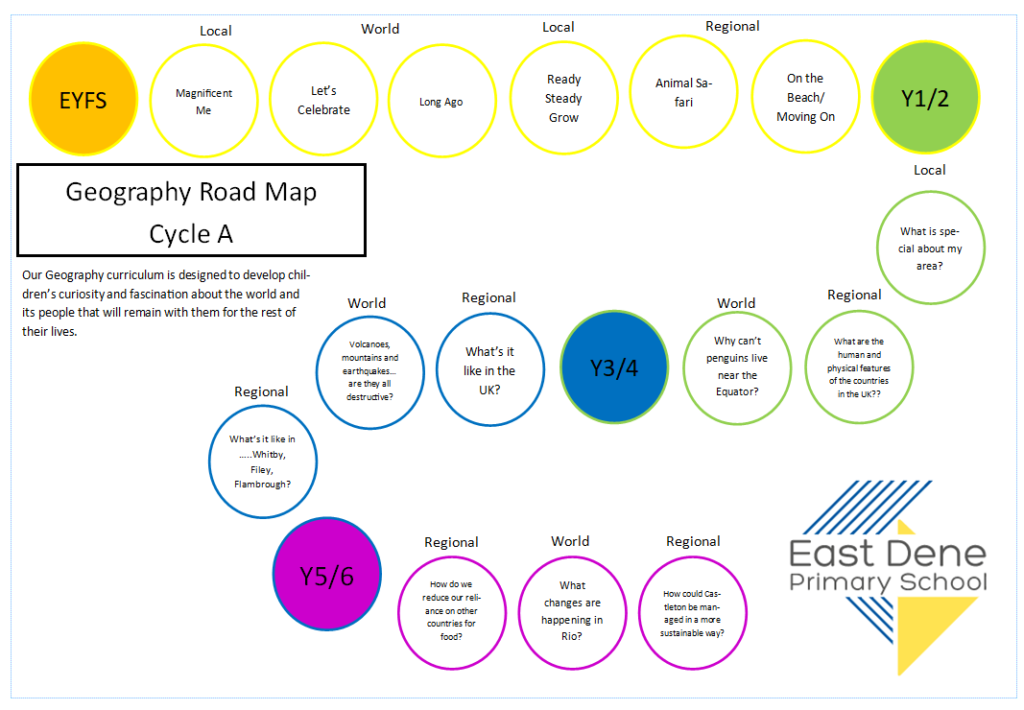
Curriculum Map
Progress Model
Progression of Language
How We Teach Geography
Intent:
At our primary school in Rotherham, South Yorkshire, the geography curriculum seeks to nurture a deep fascination with the diversity of people, places, cultures, and environments globally. Aligned with the quality statements in the Ofsted Subject Inspection Handbook for Geography (2023), our curriculum is ambitious, coherently planned, and sequenced to ensure progression in both geographical knowledge and skills.
The curriculum aims to:
- Spark curiosity about the world through interactive lessons and local fieldwork that connects to pupils’ lived experiences.
- Develop spatial thinking, mapwork skills, and geographical vocabulary in line with the latest Ofsted focus on disciplinary literacy.
- Enable pupils to investigate places, patterns, and physical/human processes using geographical enquiry, fostering critical thinking.
- Equip pupils to analyse issues from multiple perspectives, appreciating cultural and environmental diversity.
- Foster a passion for places and environments, inspiring future studies and careers in geography and related fields.
- Build cultural capital so that pupils develop detailed locational knowledge and strong spatial awareness.
By achieving these aims, pupils will demonstrate key aspects of high-quality geography education as highlighted by Ofsted: contextual and locational knowledge, fieldwork proficiency, and geographical thinking. They will also see the relevance of geography to their lives, backgrounds, and future opportunities. The “golden thread” concepts running through the curriculum include place, environment, space, scale, diversity, change, interconnection, and sustainability.
Implementation:
Our geography curriculum will be implemented through:
- A coherently planned and progressively sequenced scheme of work built around enquiry questions and recurring “golden thread” concepts: place, environment, space, scale, diversity, change, interconnection, and sustainability.
- Interactive lessons employing a range of diverse, high-quality resources to explore key geographical concepts.
- Regular fieldwork opportunities that deepen understanding of core concepts within local and wider contexts.
- Cross-curricular links to reinforce conceptual understanding across subjects such as history, science, and literacy, promoting a holistic approach to learning.
- Continuous, low-stakes quizzes and formative assessments to check pupils’ understanding, ensuring that they build on prior knowledge and retain learning over time through long-term retrieval practices.
- Collaborative planning and CPD sessions, focusing on embedding and revisiting recurring geographical concepts across all key stages.
- Home learning activities designed to consolidate and extend pupils’ conceptual understanding in different contexts, promoting metacognitive reflection.
- A spiral curriculum model that progressively adds layers of complexity to key concepts over time, ensuring a deep, enduring understanding.
Our approach begins with strong conceptual foundations in KS1, which are revisited, reinforced, and extended as pupils progress through KS2.
Each phase has long-term plans tailored to year groups:
- EYFS follows the Early Years Framework, focusing on exploration and understanding of the world around them.
- In KS1, pupils engage in three geography enquiries per year, designed to build fundamental geographical knowledge and enquiry skills.
- KS2 classes undertake two geography enquiries per year, with Upper KS2 (Y5/6) following a two-year teaching cycle to ensure coverage of the full curriculum in mixed-year classes.
This flexible implementation will adapt to pupils’ needs while maintaining a focus on progressively developing their conceptual understanding of geography’s “golden threads.”
Impact:
A successful geography curriculum will equip pupils with both substantive and disciplinary knowledge, enabling them to understand the world and their place within it. When implemented effectively, the curriculum will:
- Inspire a sense of wonder about places, people, and environments, evidenced through pupil voice, surveys, and classroom observations.
- Enable pupils to think geographically, applying key concepts, skills, and vocabulary in lessons, as demonstrated in assessments and work scrutiny.
- Empower pupils to investigate issues critically, analyse patterns, and propose solutions, as reflected in topic assessments and project work.
- Prepare pupils to actively engage as global citizens, with participation and learner attributes tracked through pupil voice and classroom engagement.
- Foster a sustained interest in geography, leading to further study, as indicated by uptake at GCSE and beyond.
- Develop confident, resilient learners equipped with the knowledge, skills, and cultural capital needed for future success, monitored through well-being surveys, observations, and academic outcomes.
The impact of the curriculum will be measured through:
- Regular low-stakes quizzes, formative assessments, and long-term retrieval activities to ensure pupils remember and build upon previous enquiries.
- Moderation and scrutiny of pupils’ geography work to ensure high standards.
- Lesson observations and pupil voice activities to gauge engagement and curiosity.
- Tracking of pupil participation, engagement, and well-being across geography lessons.
- Analysis of geography uptake at KS4, alongside the development of aspirational outcomes for pupils.
Ultimately, the curriculum will lead pupils to value geographical learning, apply it meaningfully in their daily lives, and approach the subject with curiosity, ambition, and critical thinking. High-quality geography education will help prepare our pupils to play active, informed, and ethical roles in society.
How Parents/Carers Can Help
Geography is all around us!
Ask children questions and let them ask questions about what is around them.
When you are out around town and the area you live question
- How are places changing?
- Why are places changing?
When travelling to different places question
- Where are you going?
- What does the sign post say?
- Can you locate the area on a map?
If you are on holiday question
- How is this area different to home?
- How is this area similar to home?
Free places to see and visit in Rotherham
- Clifton Park and Museum
- Thrybergh County Park
- Chapel of our Lady on the Bridge
- Rotherham Minister Church
- Ulley Reservoir Country Park
- Kepples Column
Research Around the Curriculum
Ofsted Education Inspection Framework (2019):
- Emphasizes the importance of schools providing an “ambitious, broad and balanced curriculum.”
- States that inspectors will assess “the extent to which the school’s curriculum sets out the knowledge and skills that pupils will gain.”
- Highlights the role of “sequencing that is logical and progressive” in curriculums.
- Geography is included as one of the core subjects for inspecting curriculum quality and standards.
Ofsted Research Review Series: Geography (2011):
- Found fieldwork, local area studies, and map skills are important starting points for primary geography.
- Emphasized “the role of knowledge, skills and understanding in shaping pupils’ views of the world.”
- Recommended broad topics like water, weather, settlements to engage pupils.
- Noted teacher subject knowledge, resources, planning and assessment impact quality.
Ofsted Subject Professional Development Materials: Geography (2020):
- Advises building locational knowledge of the world and UK from the start.
- Notes geography “allows pupils to make sense of current events and issues.”
- Emphasizes fieldwork skills like observation, collecting/analyzing data.
- Highlights the role of key concepts like place, space, scale and environment.
- Provides examples of effective curriculum sequences, lessons and assessments.
Organizations:
The Geographical Association:
- Publishes a wide range of research-informed curriculum guidance documents for primary schools.
- Their Primary Geography journal highlights effective teaching strategies and case studies.
- Extensive library of CPD resources including webinars, self-study courses, workshops and conferences.
- Develops research-based teaching units, fieldwork resources, atlases, and assessment materials for purchase.
- Grants available for teachers to undertake action research or geography investigations.
Royal Geographical Society:
- Involved in educational research projects, surveys and publications focused on geography.
- Created the Geography Quality Mark award to help schools evaluate their curriculum.
- Offers geography-focused professional development courses for teachers.
- Provides educational resources like maps, videos and publications to members.
- Engages in outreach through public lectures, community projects and youth participation.
National Geographic Education:
- Funds geography education research like the National Geographic Geo-Inquiry surveys.
- Develops instructional resources aligned to research on high-quality geography education.
- Provides professional development webinars and training focused on concepts like spatial thinking.
- Administers grants to teachers to support geography teaching and projects.
- Shares real-world case studies, lesson plans, activities linked to researchers and explorers
Academic Research:
International Research in Geographical and Environmental Education:
- Publishes empirical studies on innovations in geography teaching methods, curriculum, assessments etc.
- Recent topics include spatial thinking in the curriculum, virtual fieldtrips, diversity in geography, social justice pedagogy.
- Provides insights into effective teaching strategies backed by academic research studies.
- Includes literature reviews synthesizing key research around issues in geography education.
International Journal of Early Years Education:
- Covers studies on improving preschool and early primary geography and environmental education.
- Sample topics: children’s spatial skills development, play-based geography learning, concepts of place and space.
- Highlights creative, child-centered approaches to nurturing curiosity about the world.
- Connects child development research to building locational knowledge and mapping from a young age.
Journal of Geography in Higher Education:
- Research on undergraduate geography education provides implications for teacher training.
- Insights into student-centered teaching methods, curriculum design, fieldwork, assessment etc.
- Articles analyze key geographical concepts, themes, and ways of thinking that are foundational.
- Research on effective educational technology integration applicable to schools.

A Summary of Ofsted’s Geography Research Report
Concepts
Here are definitions for key concepts that run through our Geography curriculum at East Dene.
| Place | The human and physical characteristics that make a location unique and distinctive. Sense of place refers to the meanings and attachments people associate with places. |
| Environment | The living and non-living elements of an area and how they interact. Environments provide resources for human habitation and development |
| Space | The physical gap or distance between locations and objects. Also refers to the organization and arrangement of things in an area |
| Scale | The level of detail at which we examine phenomena, from local to national to global perspectives |
| Diversity | The variety between places and among people, cultures, landscapes, ecosystems. Geography examines the interconnections between diverse groups |
| Interconnection | How places, people, economies, cultures are linked at scales from local to global through movements of goods, technology, ideas, people |
| Change | Alterations in natural systems, human activities, landscapes, cultures, political systems over time. Geography analyses drivers and implications of change. |
| Sustainability | Meeting present needs without compromising the ability of future generations to meet their needs. Sustainable practices consider environmental, social, and economic factors. |
Examples of Planning
Recommended Reads
Useful Websites
Here are some suggested primary geography websites that could be useful for children to access at home:
- National Geographic Kids - www.natgeokids.com - Interactive games, videos, and articles on topics like wildlife, world cultures, geography, and history.
- BBC Bitesize Primary Geography - www.bbc.co.uk/bitesize/subjects/zf34jxs - Video lessons, quizzes, and activities organized by topic. Covers map skills, physical geography, human geography.
- Ordnance Survey Mapzone - www.ordnancesurvey.co.uk/mapzone - Games and resources for practicing map reading skills. Can print off maps and activities.
- Geography Games - www.geography-games.com - Fun online geography games to help learn countries, flags, cities, physical features.
- Kids Geo - www.kidsgeo.com - Interactive maps, quizzes, explorers section, and “learnography” resources.
- National Geographic Education - www.nationalgeographic.org/education - Lesson plans, interactive maps, photo galleries, and videos. “Explorer Classroom” section.
- Ordnance Survey Education - https://getoutside.ordnancesurvey.co.uk/ - Videos, activity ideas, and resources focused on map skills and local geography.
- Espresso Education - https://central.espresso.co.uk/espresso/primary_uk/home/index.html - Video lessons, interactives, and learning activities if the school has a subscription.