
Lessons
We begin by teaching the children set 1 sounds. Children can start blending sounds into words as soon as they know a small group of letters well. Once the children have been taught the first 5 sounds (m, a, s, d, t), they are then taught assisted blending using the sounds that they know. During lessons children are taught to hear sounds and blend them together in sequence to make a word. We start with blending oral sounds, then progress to reading the letters and blending them together to read the word.
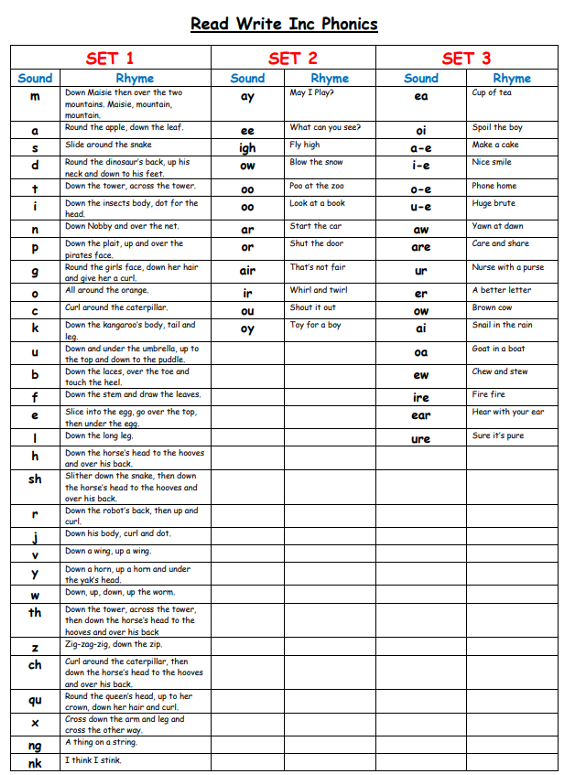
In Read Write Inc phonics the individual sounds are called ‘speed sounds’. Set 1 sounds are the single letter sounds and set 1 special friend sounds.
There are 12 Set 2 ‘speed sounds’ that are made up of two or three letters which represent just one sound, e.g. ay as in play, ee as in tree and igh as in high. These are ‘special friend’ sounds.
When children are taught Set 2 sounds they will learn:
- a simple picture prompt linked to the sound
- a short phrase to say e.g. may I play
- the letters that represent a sound (special friends) e.g. ay
Each sound has a list of green words linked to it, so that the children have the opportunity to sound out and blend words containing the new sound they have been taught, for example, s-p-r-ay = spray.
When learning Set 3 speed sounds the children will be taught alternative sounds/graphemes, e.g. ee as in tree and ea as in tea.
What order we teach the sounds
Additional Sounds Taught
| ue | Come to the rescue! |
| ie | Terrible tie! |
| au | Paul the astronaut |
| e_e | Go Steve and Pete! |
| kn | Knock knock, who’s there? |
| ck | Tick tock clock |
Nonsense words (Alien words)
As children build up their knowledge of sounds they are able to apply their decoding skills to any unfamiliar word, whether it be real or nonsense. During lessons each day children will practice their decoding skills by sounding out nonsense words. Children are unable to rely on existing knowledge of real words, and instead have to use their letter-sound knowledge. This is an important part of the Phonics Screening Check that the children complete at the end of year 1.
Learning to blend and Ditty Books
As soon as children have been taught a few initial letter sounds they begin to learn to blend the sounds together to read real words in a Word Time session. Each word time session involves oral blending of known sounds before they are shown the words written down on green cards. Children practice Fred talking the words until they become able to read them on sight. Ditty lessons follow on from this where children who are becoming excellent at reading single words are introduced to reading short sentences. Once children are confident reading the short sentences they are challenged to use their developing phonic knowledge to write a sentence.
Storybook Lessons
After ditty books, the next stage is storybooks. These books are closely matched to their developing phonic knowledge. The storybooks consist of green words linked to the sounds that they have been learning, red words and challenge words to extend the children’s vocabulary. After children have practiced these words individually they are prepared to see them in context in the story.
Comprehension activities, partner discussion and writing activities based on
the book, follow on from reading.
Reading into writing
Each story book follows a three or five day plan.
Writing activities include;
- ‘Hold a sentence’ which encourages the children to remember a whole sentence while focusing on spelling and punctuation
- ‘Build a sentence’ which gives the children the opportunity to create their own sentence to that shows the meaning of a word
- ‘Edit a sentence’ which allows the children to critique a sentence using their knowledge of spelling, punctuation and grammar.
Children then complete a longer piece of independent writing, which gives them the opportunity to show off their creativity and to practice their spelling, grammar and punctuation.