Our Curriculum
At East Dene Primary School, we are ambitious for every child. Our carefully planned and sequenced Early Years curriculum provides children with the knowledge, skills, vocabulary and experiences they need to achieve well across all areas of learning and development.
Our curriculum begins in F1 and builds progressively through to F2. We have carefully identified the most important knowledge, skills and experiences that children need in order to achieve the Early Learning Goals and be fully prepared for the next stage of their education. Alongside securing the expected standards, our curriculum also provides opportunities for children to deepen and extend their learning, enabling many children to demonstrate strong levels of understanding, independence, communication and problem solving.
The Seven Areas of Learning
Our curriculum encompasses all seven areas of learning and development within the Early Years Foundation Stage:
- Communication and Language
- Personal, Social and Emotional Development
- Physical Development
- Literacy
- Mathematics
- Understanding the World
- Expressive Arts and Design
The areas of learning are interconnected. Carefully chosen teaching, texts, vocabulary and experiences enable children to make meaningful connections across their learning and develop an increasingly rich understanding of the world.
We place a strong emphasis on communication and language, vocabulary development and fostering a lifelong love of reading. High-quality interactions, stories, rhymes and meaningful conversations are woven throughout our curriculum, teaching and children’s play.
Our Progress Models
For each area of learning, we have developed detailed Progress Models which map out the essential knowledge and skills children will develop across F1 and F2.
These models provide practitioners with a clear understanding of what children have learned, what they need to learn next and how learning builds over time. They support staff in identifying children’s starting points, addressing gaps in learning and maintaining high expectations for all children. Important knowledge and skills are deliberately revisited and developed with increasing depth and challenge. This helps children to remember more, know more and do more, whilst ensuring they are well prepared to achieve the expected standards by the end of Reception.
How We Teach and Learn
Young children learn in different ways. Our skilled practitioners use a carefully considered balance of direct teaching, high-quality interactions, purposeful play and exploration to ensure that teaching is responsive to children’s needs and moves learning forward.
Our indoor and outdoor environments are intentionally designed to support our curriculum. Continuous provision is carefully planned and reviewed to ensure children have repeated opportunities to practise, apply and deepen their learning independently.
Alongside our continuous provision, we use ongoing assessment to identify children’s strengths, gaps and next steps. Enhancements to provision are carefully chosen to reinforce key learning, provide additional challenge and support children in securing important knowledge and skills through meaningful experiences.
Adults use their knowledge of each child to decide when to model, explain, question, introduce new vocabulary, extend thinking or allow children time to explore independently. This responsive approach ensures that teaching, interactions and provision work together to help children achieve highly across the curriculum.
Learning Through Purposeful Play
Play is fundamental to how young children learn. Through meaningful self-initiated play, children investigate, communicate, create, imagine, collaborate, solve problems and make sense of their experiences.
To ensure the learning that develops through play is recognised and strengthened, we have created Common Play Behaviour Models. These outline the knowledge, skills and learning behaviours children develop through different types of play and show how play becomes increasingly sophisticated as children progress through F1 and F2.
Practitioners use these models to identify opportunities to deepen learning through skilful interactions, carefully chosen resources and thoughtful enhancements to the environment.
Together, our Progress Models and Common Play Behaviour Models provide practitioners with a shared understanding of both the curriculum we explicitly teach and the valuable learning that develops through children’s play.
Explore our Common Play Behaviour Models
Reading, Phonics and Early Writing
The foundations of successful reading and writing begin with communication, language and a love of books.
From F1 onwards, children are immersed in stories, songs, rhymes and rich conversation. High-quality texts are carefully chosen across our curriculum to broaden vocabulary, develop comprehension and introduce children to ideas, experiences and worlds beyond their own.
Children progressively develop the foundations for reading through listening, attention and phonological awareness. In F2, children are taught to read systematically through Read Write Inc. Phonics, developing increasingly secure decoding, fluency and comprehension skills.
Our approach to early writing is equally progressive. Physical development, fine motor control, drawing, mark making, oral composition and transcription are carefully developed throughout F1 and F2, providing children with the foundations they need to become confident and increasingly independent writers.
Our Curriculum Overviews
Our Curriculum Overviews set out the learning children will encounter throughout the year in F1 and F2.
They bring together carefully selected knowledge, skills, vocabulary, texts and experiences, ensuring children experience a broad, ambitious and coherent curriculum that prepares them for future learning.
Our curriculum is ambitious for all children, including those who are disadvantaged, have SEND or face other barriers to their learning. Appropriate adaptations are made to ensure every child can access and benefit from the curriculum, whilst maintaining high expectations for achievement.
What Are We Learning This Half Term?
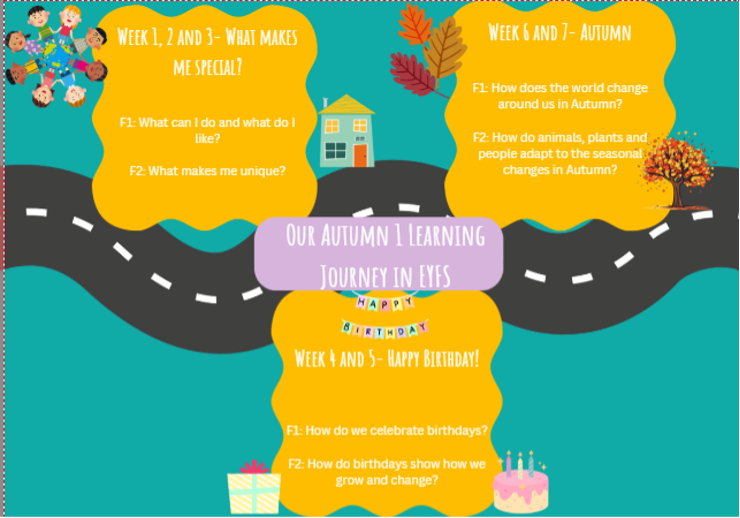
This half term, our children are exploring exciting and engaging learning opportunities as part of our Autumn 1 curriculum. These experiences provide meaningful opportunities for children to develop knowledge and vocabulary, build upon what they already know and make connections across all areas of learning.
Learning is carefully adapted across F1 and F2 to ensure children experience increasing depth, challenge and independence as they progress through the Early Years.
Autumn 1 Learning Journey